

This material is aimed at students using Making Maps: A Visual Guide to Map Design for GIS but is certainly a joy for anyone to peruse and engage.
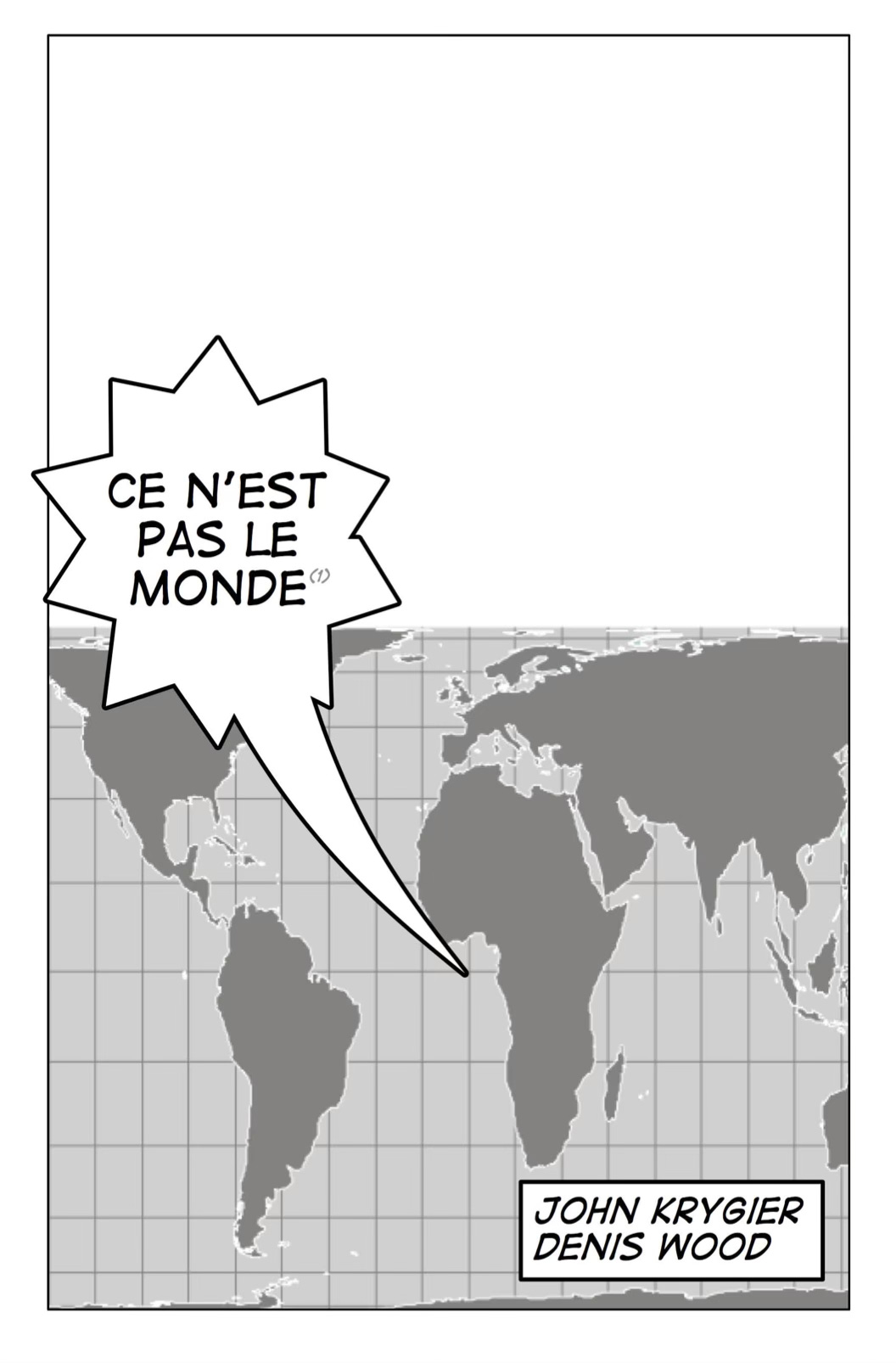
PDF with Correct Facing Pages: Ce n’est pas le monde
Google Slides with Correct Facing Pages: Ce n’est pas le monde
Back in 2006, not long after the 1st edition of Making Maps was published, Denis Wood and John Fels were working on a book eventually called The Natures of Maps. originally contracted by ESRI Press, they (for unexplained reasons) canceled the contract after the book was complete and set up for printing. It would be interesting to know why…
The University of Chicago Press picked up the book and published it in 2008.
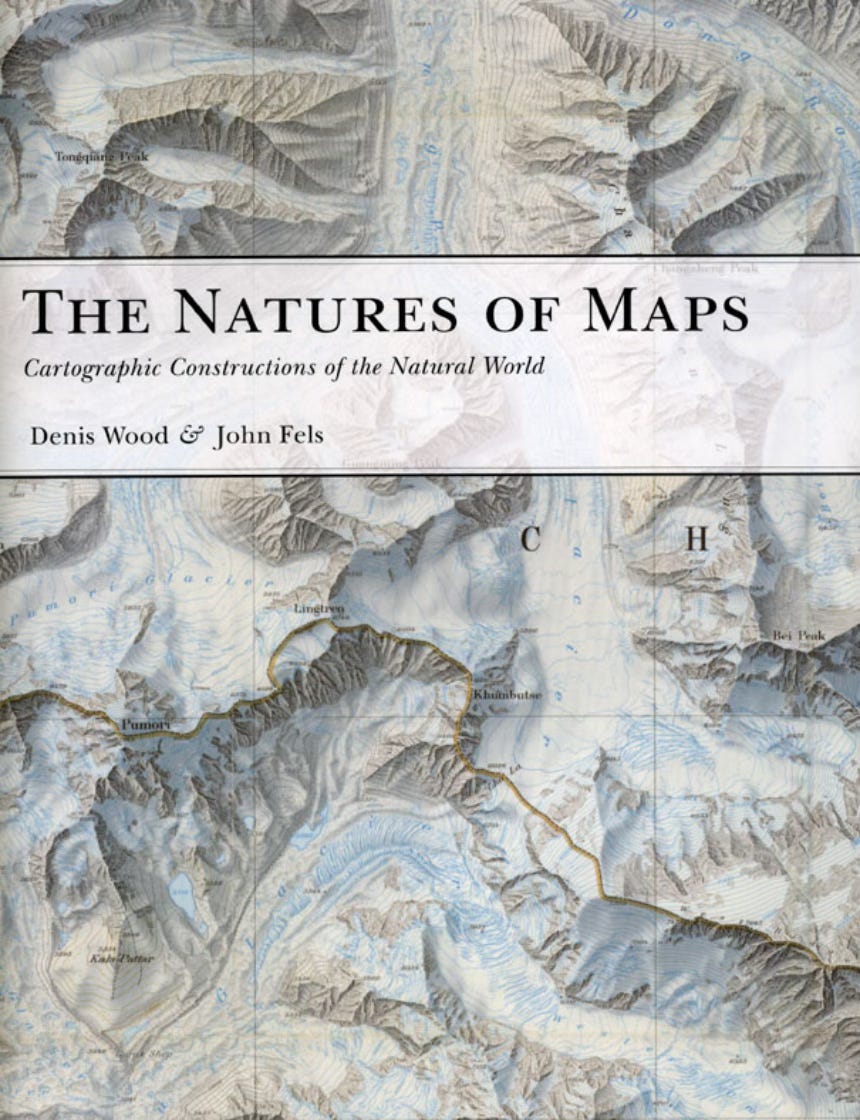
At the core of this book is the idea that maps are propositions. To ensure that this argument (!) about maps was thorough, the focus was on mapping nature. Maps of social stuff are often rife with human constructs (like political boundaries). Thus, if maps are a kind of argument, it should apply to all maps, including maps of natural phenomena (which typically are seen as closer to some kind of objective reality). It’s worth taking a look at this book. Lots of cool maps.
I’ll admit that I got a bit fuddled by all the intense discussion of propositional logic and related content and thought a more user-friendly exposition of the idea was warranted. Thus the idea for a comic book that argued that maps are propositions. the title: Ce n’est pas le monde.
I’ve never been much of a comic book or graphic novel person but I was interested in the emerging academic literature on these genres. Scott McCloud’s Understanding Comics (a 1994 comic book that was a conceptual tome about comics) inspired the format. There are tons of fascinating endnotes in the comic Denis and I created: in essence, a shadow text (in text) that explains the graphics. McCloud’s book is well worth checking out for anyone thinking about visual expression (including maps).
Denis and I printed up copies of the comic book and presented it at NACIS (in Madison, WI). At a subsequent AAG meeting Denis and I found ourselves on the prospectus for a book to be edited by Rob Kitchin and Martin Dodge that was eventually published as Rethinking Maps in 2008. Neither of us recall talking to Rob or Martin about this book, but we did receive a request for a chapter and submitted what we had: the comic book, Ce n’est pas le monde. The goal was to see if we could get a comic book (albeit an academic one, with lots of deep thinkin’ endnotes) published in a peer-reviewed edited book. It worked! I did hear that at least one of the editors did not like the submission. That’s good. If you find yourself generating stuff that everyone thinks is great all the time you are probably boring.
Long backstory, but Ce n’est pas le monde is worthy of a perusal: given the long tradition of thinking about maps as representations, what if they were instead propositions? In the comic we review a variety of ways to define representation, and, frankly, none of them make sense given what maps are and how they work (if you think about it for a bit).
What is a proposition?
the act of offering or suggesting something to be considered, accepted, adopted, or done.
a plan or scheme proposed.
a thing, matter, or person considered as something to be dealt with or encountered: Keeping diplomatic channels open is a serious proposition.
anything stated or affirmed for discussion or illustration.
a proposal of usually illicit sexual relations.
Now maps are probably not the last bullet point, although it would be interesting to concoct a map that was a proposal of illicit sexual relations.
What you might want to do:
Review the comic, linked above, once and jot down a few reactions.
Go back and read the comic again, this time reading the end notes and jot down a few more reactions.
Consider if the argument (representation vs proposition) makes sense to you and if the argument has some validity. Why or why not?
Further, even if you are doubtful, pick a map (any map! Maybe use a generic world map) and interpret it as an argument about the world (vs. a representation of the world). Why might thinking about maps as arguments be helpful, and under what circumstances? Are there potential problems that could emerge if we all thought about maps as arguments?
Find a few more maps that seem to be arguments, maybe some that don’t seem to be arguments. Discuss the difference.
While Making Maps does not go into much conceptual detail about maps as propositions, you can read the entire book as a guide to building strong map arguments.